
Vintage Skyscrapers? The Evolution of the ‘Tube House’ in Vietnam

The architecture in Vietnam is heavily influenced by the cultures who have played a big role in the country’s history.  It’s difficult to miss the French-inspired homes with yellow walls and black wrought iron balconies or the Chinese style heavily ornamented pagodas.  Although these types of structures are found throughout the country, the one type of building that exemplifies iconic Vietnamese architecture is the “tube house”.

Tall and densely packed homes are very common in Vietnam.  They are colloquially referred to as 'tube houses' because of their narrow tube-like shape.

Tall and densely packed homes are very common in Vietnam. They are colloquially referred to as ‘tube houses’ because of their narrow tube-like shape.

When spending time in Hanoi or Ho Chi Minh City, you are sure to recognize these unique looking homes – usually 3+ floors, incredibly narrow and long, and packed like sardines in a can!  These homes are usually only found in cities because of high population density.  Historically, when people started migrating to the cities looking for work, land was scarce and the population was relatively high.  This is a stark difference from architecture in the countryside, where houses are wide with gardens on three sides of the building.

Why do they look like that?

The population growth in Saigon is no different than other cities where houses naturally tend to be smaller to accommodate a large number of people.  Yet, these ‘tube homes‘ are a truly unique solution to that problem.  The reason for this form of architectural design has to do with old taxation laws in the city.  When Ho Chi Minh City and Hanoi started to develop, the laws were such that one would be charged property tax only on the length of the front facade of the home.  Strange as it is, the overall square footage of the home made little difference!

This style of house is not new.  In fact, it dates back to the Le Dynasty (15-18th Centuries AD) where the idea was to pack as many shops and stores on a street as possible, and merchants would use the back or upstairs area as their living quarters.  These old style merchant homes are the most well preserved in Hoi An.  The multipurpose usage of space still exists today – many of these homes use their bottommost floor as a shop of some kind.  Of course, if more living space is needed, the only way to grow is up!  And, as Vietnam has a strong culture of multi-generational families living together, 4- or 5-story homes are quite common and some can be up to 7 floors high.

Tube houses can be very tall with more than 3 floors.  It may initially seem like an apartment building but it is in fact just one house!

Tube houses can be very tall with more than 3 floors. It may initially seem like an apartment building but it is in fact just one house!

A bit of an extreme take on a narrow house, don't you think?

A bit of an extreme take on a narrow house, don’t you think?

Influence around the world?

Granted, the architecture in Vietnam is unique, but narrow homes are seen around the world.  In fact, the Philippines also has narrow homes that are only marginally different in design in comparison to the homes in Vietnam.  The State of California is also no stranger to multi-story tube homes.  San Francisco has a high urban density and some homes are generally narrower, although not as packed as in Vietnam.  New development along Santa Monica beach in California looks remarkably similar the Vietnamese tube homes, but with a bit more sophisticated flair!  Did Vietnam make them first and influence everyone else?  In comparison to the western world, Vietnam thought of the idea first of course but it’s doubtful that these homes were modeled after architecture in Vietnam.  Relative to the Philippines, it’s hard to say for sure.  Some ethnologists say ‘yes’, but many have noted that these homes in the Philippines and Vietnam came about at around the same time and perhaps influenced each other.  However, in terms of sheer number of these homes, Vietnam beats out its competition, hands down!  :)

Tube style houses around the world - along Santa Monica beach in California and in the Philippines.  The homes in California seem to take on this shape due to land value and space constraints.  The homes in the Philippines look surprisingly similar to the tube homes in Vietnam.

Tube style houses around the world – along Santa Monica beach in California and in the Philippines. The homes in California seem to take on this shape due to land value and space constraints. The homes in the Philippines look surprisingly similar to the tube homes in Vietnam.

What’s inside?

These homes are also quite interesting in their layout.  The bottom floor is usually a shop or a reception area/garage.  Of course this is not a garage for cars but for motorbikes, the vehicle of choice in Vietnam!  The kitchen is usually at the back of the first floor or the second floor.  The floor with the main living space is also the floor for the grandparents.  The other floors are usually just bedrooms for everyone else living in the house.  The roof area, which is usually open air or partially covered, is reserved for a little garden, lounge space, exercise area and the water tank!

Here is a typical layout of a Vietnamese tube home!

The general layout of a 'tube house' in Vietnam.

The general layout of a ‘tube house’ in Vietnam.


We hope you enjoyed learning a bit about architecture in Vietnam!  To learn more about the architecture in Ho Chi Minh City, both old and new, join us on our XO Tours Sights Tour!

Women Travellers – Cultural Sensitivity and Safety in Vietnam

In light of recent violent acts against women around the world, we think it is only fitting that we tell you a little bit about being a woman traveler in Vietnam.  We feel that it is important to understand the rules of the game when visiting a new country because women travelers may face unique challenges.  Some major issues that concern women travelers are unwelcome attention from men, physical assault, or varying perceptions of gender roles.  Fortunately, Vietnam is a relatively safe country for women travelers as the incidence rate of violent crime is quite low.  Unlike other parts of the world, women are seldom the victims of sleazy gazes or derogatory advances.  Although there is inherent conservatism in the Vietnamese culture, women are well respected in society.

That being said, there are certain things that female travelers should keep in mind when traveling in Vietnam.  Aside from the very obvious points such as ‘don’t walk down dark alleys alone‘ and ‘don’t drink too much and let your guard down’, here are some Vietnam-specific things you should take into consideration:

1. Clothing – Although many female travellers choose to be less covered up when visiting Vietnam, it is best to be more respectfully dressed.  Vietnam is by no means a place where women have to be covered from head to toe.  In fact, local women can be quite stylish!  However, local residents are usually not skimpily dressed and travellers should follow suit.  As we said earlier, aggression or assault from men is not common here and we are not implying that a woman’s clothing choices should provoke any ill behaviour upon her but making smart clothing choices is the easiest way to not attract unwanted attention.  Additionally, women should be particularly respectful with clothing choices when visiting a pagoda or temple.  At these places of worship, short shorts, tiny skirts, low cut tops or bare shoulders are not considered appropriate attire.

2. Personal belongings – We have said this before in this blog and here we reiterate.  Please be careful of your purses, phones and jewelry.  Thieves will go to any length to snatch purses or other valuable items.  We have read all too many stories where thieves on motorcycles have tried to grab a woman’s purse and dragged the poor woman until the purse was freed from her.  If a situation such as this arises and the perpetrator is stronger than you, the last thing you want is to be physically hurt.

3. Behaviour – Vietnam is a rapidly developing country and western trends are quickly influencing both pop culture and everyday culture.  Many youngsters are seen holding hands and being affectionate.  Although holding hands is fine, other public displays of affection are not deemed respectful.  It is not advisable to kiss in public.

4. Personal Questions – In Vietnam, it is quite common to ask about the marital status of a woman.  There is also a fair chance that some lifestyle choices may not be fully understood or supported.  Many women travelers have reported that they wore a wedding band or said that they were married simply to avoid these questions.  The locals’ exposure to tourists has grown substantially over the past few years but it is possible that you will encounter some people who do not agree or understand why a woman is unmarried past a certain age or is in a common law relationship.

Another question you may encounter often is about your age.  It is very common to establish your age in comparison to the the person asking because it denotes how they address you in the Vietnamese language.  For a westerner, this notion can be a bit strange because one never asks a woman’s age unless you’ve reached a certain comfort level!  Though these questions may come across as offensive, it is not the intention.

5. Transportation – The motorcycle is definitely the vehicle of choice in Vietnam.  One form of public transportation here is the ‘xe om’, which literally means ‘hugging bike’.  Many men around the city will offer rides to tourists on the back of their motorbike for the fraction of the cost of a regular taxi.  The xe om is fast, cheap and more agile in the crazy city traffic.  Many tourists, including women, take the xe om without consequence.  Some women may have a difficult time getting on a bike with a stranger but for the most part they are safe.  The etiquette when on the bike is that if you are a woman, you can put your hands around the driver’s waist (but you may certainly ask first if it makes you feel more comfortable).  Men are to put their hands on the driver’s shoulder.  At night, however, we highly advise women to take taxis rather than xe om mainly because of the personal safety factor.  An added reason is that drinking and driving is becoming an increasing concern in Vietnam so it is more likely that taxi drivers will drive responsibly since they are actually ‘on duty’.

Female tourists do take the xe om to get around the city, but we advise this only during the day time.

Female tourists do take the xe om to get around the city, but we advise this only during the day time.


We wish you safe travels from XO Tours!  If you want to learn more about how we ensure safety on our tours, read about the XO Tours Accident Insurance!

Breaking Down the Banh Mi (Vietnamese Sandwich)

As a traveller in Vietnam, Banh Mi is one of the safer street foods you can enjoy (take a look at our previous blog post for more tips on food safety).  Most of the fillings are cooked, cured or pickled and there is no water involved.  Banh Mi, which is the name for both the bread and the sandwich, is also the quintessential fusion Vietnamese dish – the ingredients have roots in old Vietnam, French colonial Vietnam, and New World cuisine.  We encourage you to try this sandwich concoction in Vietnam, at least once. :)

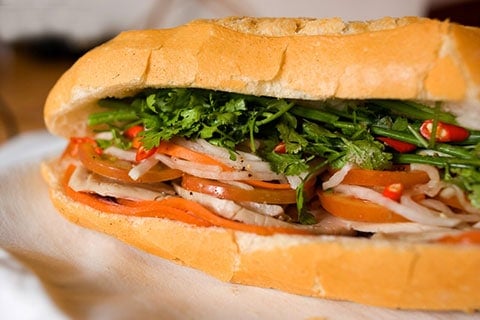
banh mi sandwich

That being said, many people find the Banh Mi a little daunting because the fillings and condiments are often things that foreigners are unfamiliar with.  Vietnam is definitely a land of exotic foods and Banh Mi fillings are no different, but we want to explain all of the intricacies of the sandwich so that you know exactly what you’re ordering!

It’s All About the Bread

banh mi bread

Although they call it a baguette, it’s not your traditional French baguette.  The Vietnamese baguette is a combination of French baking and Asian baking.  The bread is baked using the classic technique, making the baguette crispy on the outside and soft on the inside.  To throw in a bit of Asian flair, the Banh Mi bread is made with half wheat and half rice flour to give it that light and airy feel.  The bread is really the vessel that brings all the flavours of this sandwich together so make sure you notice and appreciate the bread when you bite into your Banh Mi!

What’s In It?

A guide to recognizing all the fillings in Banh Mi

A guide to recognizing all the fillings in Banh Mi

Here is an explanation of all the fillings you are most likely to see at the Banh Mi stand -

Cha or Cha Lua (Pork Roll) – Ground pork is rolled and packed into a banana leaf and then steamed or boiled.  The roll is then sliced before adding to the sandwich.  This is probably one of the most common Banh Mi fillings.

Thit Nguoi (Cured Cold Cuts) – The literal translation is ‘cold meat’ and that’s exactly what it is.  This is a composition of cured pork and fat and cut into class cold cut-type slices.

Gio Thu (Headcheese) – You may have noticed that pork is an extremely popular meat choice but this particular product might be very unfamiliar to you.  Headcheese is a processed product made from tendons, pig ears, skin and other pork head products.

Thit Nuong (Grilled Meat, usually Pork) – More pork!  Marinated pork is grilled and sliced thin.

Xa Xiu (BBQ Pork) – Small pieces of barbecued pork having a distinct coal smoke flavour.  The particular cut of pork varies.

Bi (Shredded Pork Skin) – This filling can be a bit dry because it’s thinly sliced pork skin.  This filling is usually combined with another product.

Xiu Mai (Meatballs) – Once again, pork. :) These are spiced, ground pork meatballs and have a distinct tomato flavour.

Nem Nuong (Pork Patties) – These are also ground pork, but shaped into a patty with infused garlic flavours.

Ga Nuong (Grilled Chicken) – For those who are not a fan of pork, don’t worry – there are other options!  This is marinated and grilled chicken, usually chicken thigh.

Ca Moi (Packed Sardines) – You may notice little red coloured cans at your nearest Banh Mi stand.  These are packed sardines in a tomato sauce.  They make for a great sandwich filling but they are definitely just out of the can.

Pate – Pate is extremely popular as a Banh Mi filling and is often combined with other fillings.  It can be made from pork, duck or chicken liver.

Trung Chien or Op La (Fried Eggs) – You will see eggs at a Banh Mi stand quite often.  Banh Mi Op La is an extremely popular breakfast snack in Vietnam.

The Filler

A sandwich isn’t a sandwich without the little something extra that makes all the flavours pop!  Here is a list of classic Banh Mi condiments -

Pate – Yes, pate is also used as a condiment to moisten the sandwich.

‘Mayo’ – We put mayo in quotation marks because this isn’t Hellmann’s Mayo out of a jar (although sometimes it is, which is unfortunate).  Traditionally, the mayo used in Banh Mi is actually cut with butter to add that melty feel and nutty flavour.

Fresh Herbs – Most often, it is sprigs of cilantro but other herbs are common as well.

Pickled Vegetables – Finely shredded or julienned daikon and/or carrots are pickled in a vinegar concoction and add the perfect amount of sour punch to brighten the flavours of the sandwich.

Chillies – The slices of chillies may be thin but they are quite spicy here!

Cucumber – Self explanatory. :)

Soy Sauce – a little dash of it, although some drier fillings like pork skin require a bit more.  Don’t be afraid to ask for more if you think it needs it!

Bon apetit!


We hope you enjoyed this tip on Vietnamese food!  To learn more about how you can enjoy Vietnamese delicacies with XO Tours, check out our Foodie Tour!

How to use a mobile phone in Vietnam in 5 easy steps!

Cell phones are an essential part of travel nowadays.  Whether it be for calling home, calling hotels, planning logistics, map surfing, navigating, or Facebook-ing, your cell phone is the one-stop resource for it all.  Of course, every country has their own system, so for your stay in Vietnam, we have put together a simple 5-step process in understanding the ins and outs of cell phone usage.

5 steps to using a cell phone

1.  THINK ABOUT YOUR PHONE

You have three options: bring an locked phone with you, bring an unlocked phone with you, or buy a relatively cheap phone here.  If you bring a locked phone, make sure you understand the terms for international roaming.  With an unlocked phone or a phone that you buy here, you can simply purchase a SIM card and have a local number.  Keep in mind that the unlocked phone that you bring must be a GSM phone, but most phones are these days.  Smart phones are beneficial here because you can have access to the 3G network.

2.  FIND A SIM CARD

There are stalls, stores, booths, carts and even bicycles that will sell SIM cards the minute that you land in Vietnam (we are not exaggerating… there are establishments in and around the airport!).  If you can wait a bit, ask the staff at your hotel or hostel to point you towards the nearest telecommunications store.  The associates at the store will provide a SIM card for you, cut the card according to your phone and install it for you.  For the best coverage, ensure that the SIM card you get is either on the Viettel, Mobifone or Vinafone networks.  These three companies control 90% of the mobile market in Vietnam and offer great coverage throughout the country.  Before you walk out of the store, make sure you check that the phone works.

Alternatively, check out this service – www.simcardasia.com.  They will send you a SIM Card in the mail before your trip so that you can pass on your temporary number to family and friends before embarking on your journey.  For Vietnam, the SIM Card they provide to you is on the Viettel network.

3.  SET UP 3G

Fortunately, the three top mobile companies also provide decent 3G service in Vietnam.  Having 3G can be extremely beneficial to navigate around, especially since Google Maps works very well in the cities.  More importantly, you can be in constant touch with the outside world via Facebook, Twitter, or social outlet of your choice!  And if you find yourself in a bind, you can access our XO Tours blog for travel advice on the go!  The set up is a little bit tricky but not difficult.  The basic procedure is the same for all companies but the details might differ.  In general, you will have to send a text message along the lines of “3G ON” to a special network number (eg. *888) and then configure your phone’s settings, but many mobile stores will do it for you.  If not, they will give you the detailed procedure so you can do it on your own.

4.  UNDERSTAND THE USAGE RULES

There are very few differences between the companies as to how much local calls, international calls and text messages cost, and they are quite low.  To give you an idea, on Mobifone, a phone call to a cell phone on another network is 1800VND/min and an international text message is 2500VND/text.  The exact details can be found on their respective websites.

The initial SIM Card that you purchase will come with pre-paid minutes in a denomination that you choose.  It will also come with an expiration so choose wisely.  For instance, the 100,000 VND card may expire in 7 days and the 200,000 VND card may expire in 30 days.  If you plan on being in Vietnam for around 1 month, it might be beneficial to choose the option that spans the entire time you will be here.  Topping up your minutes is also quite easy.  In order to top up, you can purchase a minutes card that looks like a ‘scratch-n-win’ card in any denomination that you want.  When you scratch the card, it will reveal a 12 digit activation card.  Then, simply enter *100*code# and ‘Send’.  You will get a message instantly saying that your minutes have been topped up.  Dial *101# to check your balance as you go.

5.  UNDERSTAND THE PHONE NUMBERS

Once you have your phone ready to go, you will need to know how to dial phone numbers here as it may be different than what you are used to.  Here are the basics -

Country Code: + 84

Trunk Prefix: 0

International Prefix: 00

Land Line format:  Area Code (1 to 3 digits) + Phone Number (5 to 8 digits)

Cell Phone format: 09y xxx-xxxx or 01yy xxx-xxxx

FROM: Land Line  TO: Local Land Line

Area Code + Phone Number

FROM: Land Line  TO: Cell Phone

09y xxx-xxxx or 01yy xxx-xxxx

FROM: Cell Phone  TO: Land Line

0 + Area Code + Phone Number

FROM: Cell Phone  TO: Cell Phone

09y xxx-xxxx or 01yy xxx-xxxx

FROM: Anything  TO: International Phone Number

00 + Country Code + (Area Code + Phone Number) or (Cell Phone format)


We hope you found this travel tip useful!  To find more useful information about XO Tours and Vietnam, take a look at our FAQ section!

Vantage Point: The Location for the Extraordinary Photo!

The skyline of Saigon at night

The skyline of Saigon at night

Ho Chi Minh City is a unique city in that it is rapidly growing but has yet to develop into a massive skyscraper filled concrete jungle.  While it is transforming into a cosmopolitan world city, it still retains some of its old world charm.  The city is rich with nooks and crannies, alleyways and narrow motorbike-filled roads, and areas unexplored by the majority of tourists, making it a very different type of place to explore.  These features of Ho Chi Minh City make it a veritable playground for photography enthusiasts because you can take pictures here that will be distinctly unique.  The irony is that this also makes it difficult to find the perfect spots to capture those exotic moments.  We have compiled a simple guide to finding the best vantage points in Ho Chi Minh City to inspire your urban photography.

LANDSCAPE

Even though the city has little to offer in terms of mountains and oceans, the topography is unique enough to create a beautiful silhouette.  The Saigon River offers an interesting perspective for photographers because there are many spots along the river where one can look back and see the skyline or simply appreciate the sunrise and sunset.

Vantage Point:  For a great shot of the complete skyline, go to either the Kinh Te or Thu Thiem bridge.  Sunset is usually around 6 pm in the evening so try and catch the sun setting on the city!  Note that the Bitexco Tower is the tallest building in the city and although it has a viewing deck on one of it’s upper floors, the skyline seems underwhelming from this perspective.

The Saigon Sunset

The Saigon Sunset

If you are more a fan of greener landscapes, you will have to venture a bit outside of the city but fortunately not too far away.  One of the most popular places for wedding photographs around the city is a theme park of sorts, called Binh Quoi 1.  The Binh Quoi Village is lush and green, and it has waterways with traditional boats and boatsmen.  If you go at the right time, you may even see couples taking wedding shots.

Vantage point:  Find the pond with lilies and a water wheel or look for a spot along the water with huts and parked rowboats for a more authentic look in a fabricated paradise.

Lily pads at Binh Quoi Village

Lily pads at Binh Quoi Village

The scenery at Binh Quoi Village

The scenery at Binh Quoi Village


ARCHITECTURE

Ho Chi Minh City has some very interesting buildings.  Sure, they are not the sky reaching structures that you see elsewhere, but they are marvelous nonetheless.  The city has its fair share of old buildings that have been maintained pristinely since the French Colonial Era in Vietnam.  They hold such history and meaning, you can feel the aura of years gone by.

Vantage point:  The Notre Dame Cathedral is one of the most beautiful colonial era buildings.  Walk to the side of the building to the massive doors – they make for a cool backdrop for portrait shots!  If it happens to rain one evening, go to the City Hall in Saigon.  The way the blue lights shine off the wet pavement and reflects onto the building makes it looks mystical!  And if you go to the historical Post Office, look up!  The ceiling is an architectural masterpiece.

The City Hall glowing blue after a heavy rain.

The City Hall glowing blue after a heavy rain.

The majestic ceiling of the main Post Office.

The majestic ceiling of the main Post Office.

The city is filled with juxtapositions, especially the old with the new.  But there isn’t just one kind of old.  Next to the colonial buildings are the ages old pagodas and temples.  They offer a history of their own.  Many of them have been there since before the war, and some of them even damaged and then subsequently restored.

Vantage point: Jade Emperor Pagoda is one of the most impressive pagodas, architecturally.  But the Thien Hau Pagoda has a ceiling full of cone shaped incense burners that make for a very interesting photograph.  The many pagodas around the city also look the most magical under a haze of incense smoke – find out at what time of the day most people visit the pagoda to maximize the amount of smoke in the air!

Cone-shaped incense burners on the ceiling of the Pagoda.

Cone-shaped incense burners on the ceiling of the Pagoda.

Incense burning outside the Jade Emperor Pagoda

Incense burning outside the Jade Emperor Pagoda


CITY LIFE

The one thing that this city most definitely does not lack is the ever-moving, awe-inspiring, and at times hair-raising activity.  The people, the food and the culture are so vibrant that it is a privilege to be able to capture it on camera.  The most well known feature of Ho Chi Minh City is the traffic.  The streets are jam-packed with motorbikes – in fact, the cities in Vietnam have the highest number of motorbikes per capita in the world!

Vantage point:  Early in the morning, take a trip out to District 5 near Cho Lon.  This is where you see the motorbikes carrying the craziest things, like washing machines or giant panes of glass!  In the evening, go up to the Chill Skybar rooftop restaurant and look down onto the circle intersection below in front of Ben Thanh market.  A time lapse photo of the motorbikes zipping around the circle will capture the chaos on the roads at night!

A really cool time lapse photo taken from the top of Chill Skybar overlooking the circle outside Ben Thanh market.

A really cool time lapse photo taken from the top of Chill Skybar overlooking the circle outside Ben Thanh market.

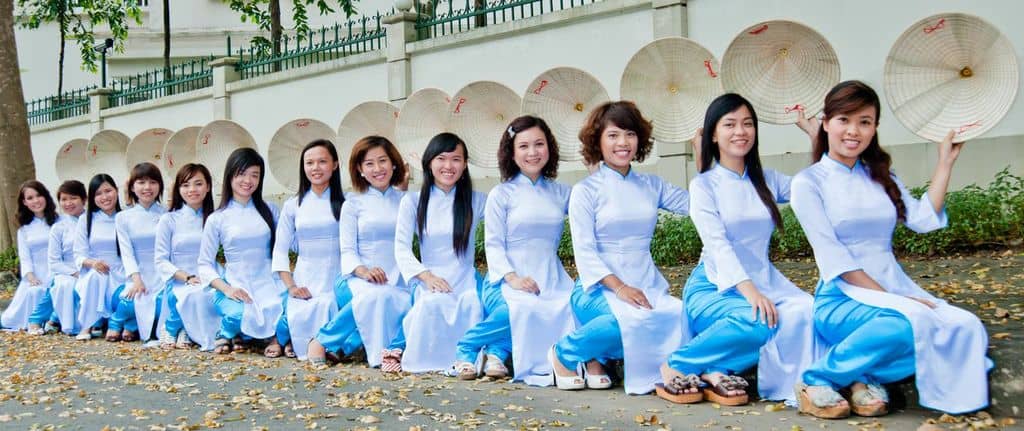
You cannot come to Vietnam and be absolutely enamoured by the people.  Vietnamese people work hard but still take time to relax and enjoy themselves.  One of the most charming sights is seeing a Vietnamese woman dressed in an Ao Dai and sauntering down the street or and elderly person finding some shade under a conical hat.  In the evenings, locals come out in full force to spend time with friends at the local watering holes or the coffee shops (yes, coffee joints were cool here long before they became popular in the rest of the world)!

Vantage point: As you’re walking around the city, take a look inside the alleyways.  They are more than just a narrow passing.  You’ll see food stalls, parked bikes, people lounging, and more!  If you’re taking a picture of a person though, ask their permission first.  Most people don’t mind but be sure to show them the photo afterwards to put a smile on their face. :)

An alley riddled with flags of Vietnam.

An alley riddled with flags of Vietnam.

Quiet alley with beautiful doors on either side.

Quiet alley with beautiful doors on either side.


We hope you enjoyed this Vietnam Travel Tip from XO Tours, offering the most unique city and food tours in Saigon!